Continued from Part 22 where we talked about how low sleep and circadian rhythm misalignment lead to overeating.
So far in this series, I’ve talked about satiety only indirectly (in terms of palatability, stress, sleep, etc.), and now in this part and the next, I want to talk about it directly.
I’m going to divide this topic into two different parts:
- The Satiety Levels of various foods
- The Satiety Level of your overall diet (Sensory specific satiety)
Not all foods fill you up equally. Some things are far more filling than others.
And this is no big secret.
Anyone with a double digit IQ and above who’s tracked their calorie intake knows that it’s very easy to eat 600 calories in pizza (just 2-3 slices) and still want more, and very difficult to eat 600 calories in vegetables (you will be full for a long while after).
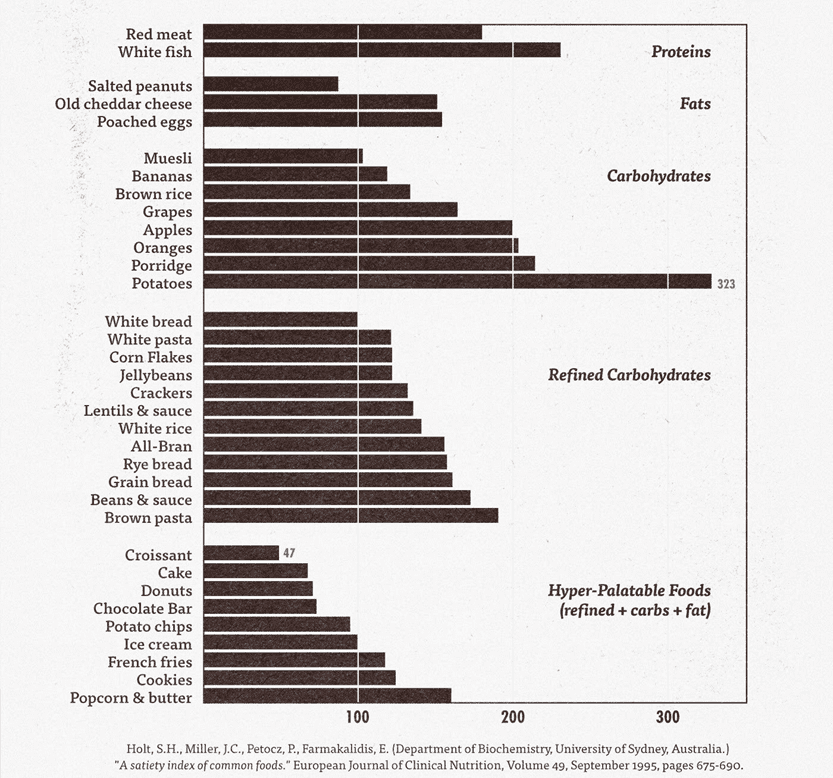
There have been studies on the satiety levels of different types of foods, there’s been rough estimates of “satiety indexes” of some popular foods:
| Rank | Food | Satiety Index (SI) |
|---|---|---|
| 1 | Plain boiled potatoes | 323 |
| 2 | White fish | 225 |
| 3 | Oatmeal/porridge | 209 |
| 4 | Oranges | 202 |
| 5 | Apples | 197 |
| 6 | Whole-wheat/brown pasta | 188 |
| 7 | Beef steak | 176 |
| 8 | Baked beans | 168 |
| 9 | Grapes | 162 |
| 10 | Wholemeal bread | 157 |
| 11 | Grain bread | 154 |
| 12 | Plain popcorn | 154 |
| 13 | All-Bran | 151 |
| 14 | Eggs | 150 |
| 15 | Cheese | 146 |
| 16 | White rice | 138 |
| 17 | Lentils | 133 |
| 18 | Brown rice | 132 |
| 19 | Honey Smacks cereal | 132 |
| 20 | Crackers | 127 |
| 21 | Cookies | 120 |
| 22 | White pasta | 119 |
| 23 | Bananas | 118 |
| 24 | Jellybeans | 118 |
| 25 | Cornflakes | 118 |
| 26 | Special K | 116 |
| 27 | French fries | 116 |
| 28 | Sustain cereal | 112 |
| 29 | White bread | 100 |
| 30 | Muesli | 100 |
| 31 | Ice cream | 96 |
| 32 | Potato chips/crisps | 91 |
| 33 | Strawberry yogurt | 88 |
| 34 | Peanuts | 84 |
| 35 | Mars bar | 70 |
| 36 | Doughnuts | 68 |
| 37 | Cake | 65 |
| 38 | Croissant | 47 |
White bread is the baseline, ranked at 100. So boiled potatoes at 323 would mean that boiled potatoes are 3 times as satiating as the equivalent number of calories in white bread. Croissant at 47 would mean that it’s about half as satiating as white bread when equated for calories.
Take the numbers with a grain of salt, because each food was only tested on 11-13 people who were asked to rate how full they felt every 15 minutes for 2 hours after eating them. They are not “hard fact” and can differ for your particular brain and body.
That said, there have been more studies since then, and there are several clear correlations between different food factors and their satiety levels.
General Trends
Whole foods with lots of water like meat, fish, oatmeal, potatoes, fruits, and vegetables, are the most satiating foods out there.
Food devoid of fiber like white bread, breakfast cereal, soft drinks, and fruit juices are less filling. Whole wheat bread is more filling than white bread.
Foods with added fats and sugars like bakery items such as cookies, cake, chocolate, etc. are also very low in satiety.
In general, foods that are low in fiber and have lots of fat and sugars are the least filling foods you can eat. Ice cream, pizza, and potato chips – you can just keep eating them and not feel full even after eating over a thousand calories.
What Makes a Food More Satiating Than Others (More Filling For The Same Number of Calories)
These are the general characteristics present in foods that are highly filling, or the general characteristics lacking in foods that are not highly satiating.
Note the word “general” – everything here is directionally correct, but you can always find exceptions.
1) Fiber
The more fiber a food has, the slower your body digests it, and the longer that food keeps you full. Whole bread is more filling than white bread, whole fruits are more filling than fruit juices, etc. for the same number of calories.
Whenever you’re eating, always choose the higher fiber version of the foods you eat. Instead of drinking juice, eat the fruit.
Vegetables are extremely filling, because they are mostly water and fiber.
2) Protein
The higher the percentage of protein in a food, the more filling it tends to be.
High protein foods are far more satiating than low protein foods (where the calories mostly come from carbohydrates and fats).
The digestive system is able to detect protein and signal it to the brain, and this protein signal seems to be much stronger than the signal for calories from carbohydrates and fats.
Chicken, fish, egg whites, etc. are all highly filling for this reason. They are very high in protein (and water – see below).
3) Water and Volume
Volume means the actual amount of the food you get to eat, and usually high volume foods are high volume because they are full of water (water adds 0 calories).
Foods with high volume/water in them tend to be highly satiating because they help physically fill your stomach.
Boiled potatoes, oatmeal, vegetables, fruits, etc. are mostly water and give you a lot to eat for not a lot of calories, and are thus very filling.
On the other hand, foods low on water and volume are usually not very filling. For example, peanut butter and nuts allow you to eat TONS of calories at once because they are just so calorie dense per unit of volume.
A spoon of peanut butter can be 100 calories, but a spoon of boiled potatoes is maybe 10 or 20 calories. This is a world of difference.
4) Lower Fat Content
The more fat a food has, the less filling it tends to be for the same amount of calories.
This is because fat is more energy dense and often also adds lubrication (making foods easy to eat), so a lot of high fat foods tend to have little volume and less water in them.
Lean meats like chicken breast are more filling than high fat meat for the same amount of calories. 5 egg whites are more filling than 1 full egg (both have about 80 calories). Potatoes are more filling than potato chips.
Now this is not to say that low carb high fat meals do not work for fat loss (lots of people lost a lot of weight on only red meat and egg diets), but they are producing satiety through eating the same foods repeatedly… something I will cover in the next part of this series.
5) Palatability
The tastier something is, the less filling it tends to be. Foods with added sugars, added fats, or cooked in ways to make them extremely delicious are not very filling.
Whole wheat bread is filling. Meat is filling. Potatoes are filling.
But you combine them together with some spices and make a burger, and then suddenly you can eat a lot of calories at once. This is because you increased the palatability of the foods by combining them and making them tastier.
I talked about this in part 19, highly palatable foods inevitably lead to overeating because they hack our brain’s reward circuits.
Your brain evolved in a time of food scarcity, so when presented with “a very good deal” (high calories, easy to digest, and good taste), the brain will alter your perception of fullness to allow you to eat more. This used to be an ingenious survival strategy that is maladaptive in the modern world where food is the opposite of scarce.
That’s all for this piece. In the next part of this series, I’m going to talk about sensory specific satiety.
| Title |
|---|