A lot of people hate leg day because it fatigues the fuck out of them and gets them sore for the next 3-4 days. Some can’t even walk properly the next day after hitting legs. In this piece I’m going to tell you how to fix your training to avoid this problem as much as possible.
This is a piece on fixing your training so I’m not going to lecture you on your sleep, diet, stress levels, hydration, and other “outside the gym” factors. I’ll assume you have all of that dialed in.
People instinctively feel that soreness and fatigue are signs of their training working. Many guys even feel proud of the fact that they are sore because they think that soreness is a sign that they are growing.
This is the “logic”:
I trained hard -> I got sore -> Soreness heals -> Muscle size increases in the process -> Therefore soreness means my muscle is growing
It seems to make logical sense.
But logic does not have anything to do with physiology.
The exact causes of soreness (more specifically known as Delayed Onset Muscle Soreness or DOMS) are not known yet, but it is thought to be coming from the damage caused to the muscle tissue/nerves from the eccentric portions of lifting (but again, no one knows for sure and there are many other hypotheses).

Even though we do not know exactly why DOMS occurs, here is a simple fact that any coach worth his salt will be able to attest:
SORENESS IS NOT GROWTH
Yep. This is going to be a surprise for many people. Soreness does not cause muscle growth. In fact, there is an inverse correlation between excess soreness and muscle growth.
The way muscle growth works is that exercise provides a stimulus to grow, and the actual growth of the muscle happens in the process of recovering from that exercise.
When you are excessively sore, much of that recovery ability goes to fixing the soreness/inflammation/muscle damage (whatever the cause) and not into growing more muscle. By the time recovery catches up, the stimulus effect is gone.
In other words, all the soreness is not helping you grow more. It means that excessive soreness is making you grow less.
You are doing more work (more sets, more reps) to get less results (less muscular hypertrophy).
I can make anybody sore by making them do 500 reps of air squats. Most will be sore for a week.
But is doing a lot of air squats making anybody build more muscle? No. All you’re doing is making them sore.(The exception is novice lifters who will grow from anything.)
So yeah, if you train with the objective of getting sore (chasing the soreness and feeling bad about your training if you didn’t get as sore as last time), you are doing it WRONG.
If your coach is encouraging debilitating soreness and acting as if it is something to be proud of, the coach should be fired immediately.
Usually bad coaching is partially a result of the “pay peanuts, get monkeys” type situations and partly the fact that anybody can call themselves a coach with no training or knowledge whatsoever (how many coaches still have people doing high volume bro splits? Far too many.).
How to Train Without Getting Extremely Sore And Fatigued
1) Stretch After Training
TONS of people get much less soreness if they stretch after their workouts. If you’re getting very sore, start here.
Spend 20-30 minutes after your training session just to stretch everything properly. Do some foam rolling if you’ve got the time.
You know all the things you keep skipping in your training because they’re boring like warm ups, cool downs, stretching, foam rolling, etc. – add them to your routine.

Note: Always do your stretches after your training. Doing them before training reduces power output and impairs your ability to lift maximal weights.
2) Rationalize Your Training Volume
The reason why most people get tons of soreness is because they follow badly designed programs that have too much volume for a muscle group in one workout.
Guys will do 10-20 sets per muscle group because they keep seeing that number online. “10-20 hard sets per week maximizes hypertrophy” is the common advice but what does that actually mean?
Here is the problem with people who think in terms of “hard sets per week”:
1) It ignores that the distribution of volume across the week matters. (It is almost always better to do 4 sets twice a week than to do 8 sets once a week because of diminishing returns)
2) It ignores how hard you push a set. What does a “hard set” mean? Failure, or 0 reps in reserve (RIR), or 1 RIR, or 2 RIR? Because nobody can do 15 high quality sets per body part to failure per week sustainably, while everyone can do 20 sets with 10 RIR (i.e. piss training)
3) It ignores rep ranges. The low rep ranges (less than 5 reps) do not give you enough effective reps, while the very high rep ranges (more than 15) may feel hard and “fail” due to cardiovascular exhaustion and not due to muscular factors.
4) It ignores the fact that because of diminishing returns, the last 20-30% of the per workout growth is not worth chasing.
If you can get 60% of the growth (per workout) with 2 sets (to 0 RIR), 80% of the growth in 4 sets, 90% of the growth with 6, and 100% with 10 (or perhaps more), for most people it’s far better to do somewhere between 2 to 4 sets and get 60% to 80% of the gains and minimize fatigue and soreness.

Again, we are talking about per workout growth.
You will eventually get to the same place physique wise because your maximum genetic potential is limited by your genetics. It might just take you 6 years instead of 4. So fucking what?

I’d say most people who take their reps to or near failure (0 RIR) should not do more than 4 sets per muscle group per workout for the simple reason that the additional growth you’re going to get is fairly minimal and the additional fatigue and soreness/muscular damage is quite real.
In practice, if your workout looks like this:
- Monday – Chest (12 sets)
- Tuesday – Back (12 sets)
- Wednesday – Shoulder (12 sets)
- Thursday – Legs (12-18 sets)
- Friday – Arms (6 sets biceps, 6 sets triceps)
Or whatever version of the above, try switching it up to something like this:
- Monday and Thursday [upper] – Chest (2-3 sets), Shoulder (2-3 sets), Back (4 sets), Biceps (2 sets), Triceps (2 sets)
- Tuesday and Friday [lower] – Quads (4 sets), Hamstrings (2-3 sets), Glutes (2 sets), Calves (2 sets), Core (2 sets)
You will not only train less, but actually end up growing more. You are less fatigued, less sore, and more motivated to train.
Make sure you have at least 2 full rest days in the week (3 if you’re over 35). On a full rest day, you do nothing – no cardio and no lifting. Just get some rest and relax. Sleep and eat.
Here is an example program that will work well for most people who want to maximize hypertrophy while keeping fatigue limited:

3) Change Your Rep-Range
If you’ve started stretching and rationalized the volume in your program, and you’re still very sore, the only major thing left to fix is the rep range.
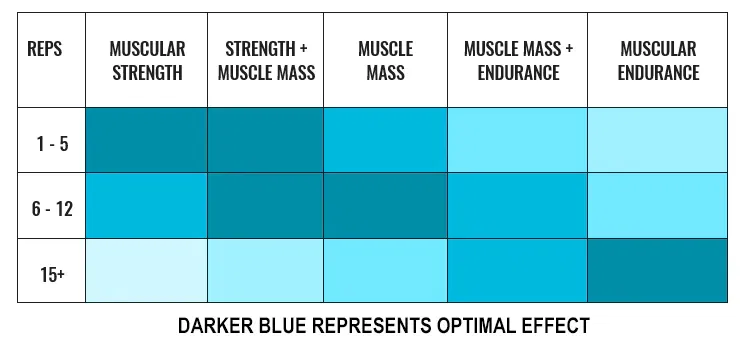
If you’re training in the 8-12 rep range like most hypertrophy focused lifters are, you should bring down the rep range for compound lifts to something like 5-8.
The hypertrophy you will get will remain the same as long as you take your sets to failure or close (0 RIR) but you will get much less fatigue and soreness.

So for your compound lifts like leg press, squat, bench press, rows, shoulder press, etc., a 5-8 rep range works great for most people.
For isolation work or exercises where small increments in weight lead to big increases in difficulty, you will still need to use high and wide rep ranges, so you don’t have much choice there.
For example doing heavy bicep isolation work for 5 reps is not that great for your biceps tendons. You’re probably better off sticking to 8-12 reps here for longevity purposes and to avoid developing elbow issues.
Likewise for cable lateral raises, if the plate increments by 5kg each, you can go from doing 8 reps to doing 0 reps by incrementing 1 plate. You might need a very wide rep range here (like 8 to 25) simply because this exercise progresses slowly.
But again, you’re not getting debilitating soreness and fatigue from lateral raises. But you will get it from doing many sets of high rep range shoulder presses. So lower the rep range in the presses.
So there you have it. This is how you train to get all the hypertrophy without being so fucking fatigued and sore all the time.
Hope this helped.
Your man,
Harsh Strongman




 wpDiscuz

![Traits Women Find Attractive (And How to Score Yourself) [PART 1: Physical Aspects]](https://lifemathmoney.b-cdn.net/wp-content/uploads/2025/11/Traits-Women-Find-Attractive-1.jpg "Traits Women Find Attractive")